
 |
|
 |
|
 |
|
 |
|
 |
|
 |
|
 |
|
 |
|
 |
|
 |
|
 |
|
 |
|
 |
|
 |
|
 |
|
 |
|
 |
|
 |
|
 |
|
 |
|
 |
|
 |
|
 |
|
 |
|
 |
|
 |
|
 |
|
 |
|
 |
|
 |
|
On January 17th 1995, the Great Hanshin Earthquake, commonly referred to as the Kobe Earthquake, killed over 6000 people in Japan. This natural disaster has made people wonder how large earthquakes could affect nuclear power plants. However, no school teaching materials refer to the risk of nuclear disasters caused by earthquakes. Does that sound right to you?
In 1922 the Great Kanto Earthquake struck Kanto and shattered downtown Tokyo. In Kansai (the west side of Japan), despite the former large earthquake that occurred in that area after the WWII, there was little or no warning there would be another one. People did not expect a large earthquake in that area until the 1995 Great Hanshin Earthquake devastated them. The occurrence of the Great Hanshin Earthquake has changed the general view of earthquakes.
 The world seismic zoning map to the right shows large earthquakes of over M (magnitude) 4. As is obvious from the map the whole Japan is located in the area where earthquakes frequently occur. You cannot see the shape of Japan on this map because the dots of the earthquakes cover the whole of the country! Japan is one of just several places on earth where earthquakes occur very frequently.
Why do earthquakes occur in specific areas? By comparing the world seismic zoning map (Fig.1) with the distribution of the world’s major plates and plate boundaries (mobile belts) (Fig.2), you can see that earthquakes frequently occur on the plate boundaries (mobile belts) where continents and the oceans lie. As you see, earthquakes do not occur throughout the earth but only on specific belts.
Geological processes deep underground that have continued for millions of years are responsible for the geological features we see on the surface of the earth today; land has become the ocean; the ocean floor has been upheaved and become mountains. The active tectogenesis concentrates on the narrow areas called “mobile belts”, and geological research shows that the mobile belts have been transiting with time. The area where earthquakes frequently occur lie on the mobile belts formed within last several hundred thousand years or several million years.
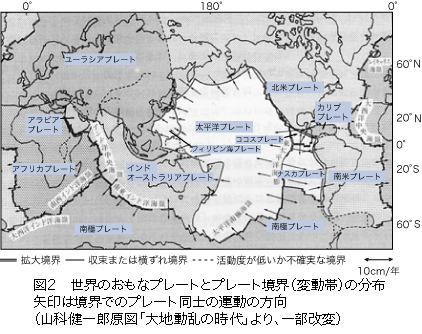 The reason why major tectogenesis and seismic volcanic activities occur only in narrow mobile belts is because the whole lithosphere that covers the earth is divided into several blocks, and each of them is moving slowly in different directions on the surface of the earth with little internal change. Excessive transformation converges on the boundaries. This situation is clearly explained if we look at the global space scale and geological time scale; ‘plate tectonics’, a system of earth science, explains this movement.
There are three types of movements of adjoined plates: moving away from each other, colliding to each other, and passing each other. The movement that is related to the occurrence of earthquakes in Japan is the ‘colliding’ action.
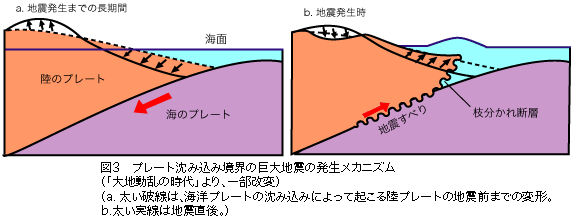
As shown in Fig. 3a, the Pacific Ocean plate subducts under the land plate of the Japanese archipelago. Accompanying this movement, excessive transformation and its resistance accumulate around the plate boundary and the weak plane inside the plate. As shown in Fig. 3b, when the transformation reaches its limit, the land plate tries to repel it and this causes an earthquake. The majority of large earthquakes, such as the 1960 Chile Earthquake (M9.5) and the 1964 Alaskan Earthquake (M9.2), have occurred on such subduction boundaries.
As shown in Fig. 1, Japan is one of the countries that earthquakes occur most frequently in the world. Why is that?
 In Fig. 4, the Japanese archipelago is located on the middle of the Pacific Ocean Plate that has a long subduction zone, and offshore there are the Kuril Trench, Japan Trench, and Izu-Ogasarawa Trench. In these trenches the subductions have been continuing for approximately 40 million years. On the west of the Izu-Ogasarawa Trench there is the Philippine Sea Plate, on the north there is the Amur Plate and the Sea of Okhotsk Plate. Around the Japanese archipelago, four plates are competing with each other. That’s why Japan has one of the highest seismic activities in the world.
As can be seen in Fig. 4, there are working nuclear power plants in areas of ongoing seism activity, and most of them are located in areas under observation, as earthquake are predicted for thase areas or adjoining these areas.
 Earthquakes occur periodically. Let’s take a look at the great earthquakes that have occurred in the area of the Suruga-Nankai Trough in the southeast offshore area of Japan as an example (Fig. 5). Many great earthquakes occur in Japan because of the four plates that are competing with each other. It is considered that the Philippine Sea Plate is involved in the cause of most of the Japanese earthquakes. This plate has been subducting rapidly towards the Kanto and Tokai area, where it accumulates colossal stresses. In the Tokai area, there has not been any large earthquake since 1854; it is said that another Tokai Earthquake will occur in the near future when these stresses are finally released.
Other than the earthquakes mentioned above, there is a type of earthquake that occurs inside of a plate, such as the South Hyogo Earthquake (1995, M7.2), and the offshore Kushiro Earthquake (1993, M7.8). This is a type of earthquake occurs directly above its epicentre and it causes enormous damage, but it is not very clear what conditions cause intraplate earthquakes.
Fig. 4 shows both regions where earthquakes frequently occur and the locations of nuclear power plants. Considering the mechanism of earthquakes, it is understandable why nuclear power plants in Japan are called “nuclear power plants on tofu” or “nuclear power plants on a catfish”. Why have so many nuclear power plants been constructed even though Japan is well-known as a kingdom of earthquakes? Let’s listen to what power companies say.
Power companies insist that they are using the safest and most reliable measures for earthquakes when building nuclear power plants. The Nuclear Safety Committee that is supposed to ensure the safety of each citizen has no complaints about what they are doing. The following link (In Japanese) gives examples of the earthquake policies for the Chubu Power Company’s website (http://www.chuden.co.jp/torikumi/fr_atom.html) and possible problems based on their earthquake policies.
 ○ We do not build nuclear power plants on active faults.
The power companies say, “We choose the locations by first confirming that there are no active faults using various investigative methods”. An active fault, according to Katsuhiko Ishibashi, is “a fault whose formation on the surface of the earth is verified with physiographical, geological and geophysical observation, and that has sheared repeatedly during the latest geological age (500000 – 1700000 years) and is expected to shear in the future”. It is logical not to build a nuclear power plants on an active fault; however, there are nuclear plants that are built on active faults. Active faults are scattered all over on the Japanese archipelago as shown in Fig. 6. Trying to avoid active faults by choosing 'non' active locations for nuclear power plants does not necessary mean safety, as researchers believe there are a number of yet undiscovered active faults, and that earthquakes could occur anywhere in Japan.
○ We investigate active faults.
Although the power companies say, “We verify that there is no active fault by using various investigative methods,” a whistle-blower exposed that sample core borings from geological surveys were found to have been discarded at the sites for nuclear reactors in Kagoshima Prefecture and Ishikawa Prefecture. Researcher, Mr. Takashi Hirose points out that this fact could indicate the power company used false samples to show that the site was on a “safe stratum”. It could be that the fundamental investigations might not be trustworthy.
 ○ Seismic design coefficient.
The power companies explain their seismic design coefficient in this manner: “For the design of the main part of the nuclear power plant, we use past seismography data and then we assume an earthquake more powerful than the biggest earthquake that could happen in this area including earthquakes caused by active faults”.
The designed earthquake resistance of nuclear power plants is calculated by estimating the size of earthquakes from the length of faults in the periphery of the site. Mathematical calculations indicate there is a relationship between the size of an earthquake and the length of surrounding faults; the longer the fault, the larger the earthquake. This mathematical calculation however is not really credible as the continuity of faults as well as their multiplicity are disregarded. Also energy multiplier effects are apt to occur, and these too are not taken into consideration in the calculations.
The Taiwan Earthquake of 1999 resulted in an 8 meter fault movement which vertically penetrated a riverbed and created a new waterfall. If an earthquake as powerful as that should occur near a nuclear power plant, the base of the plant would collapse in an instant as the foundation would vanish, even if it was very resistant to earthquakes.
○ Earthquake-resistant design is 3 times larger than the seismic force of the Standard Building Law.
“We adopt an earthquake-resistant design with an engineered safety margin; the machinery and buildings in nuclear power plants that require high security can stand an earthquake 3 times larger than the seismic force of the Standard Building Law”, say the power companies.
The PR for nuclear power plants often uses safe sounding catch phrases such as “Nuclear power plants can stand an earthquake that is 3 times as large as the Great Kanto Earthquake”; but Hirose points out that such expressions are not only wrong but big lies. As shown in Fig. 7, even the Hamaoka nuclear power station No. 3 and No. 4 units, which have the highest earthquake resistance of all the nuclear power plants in Japan, would not be able to handle the maximum acceleration of the Great Hanshin Earthquake (833 gal).
○ Tsunami measures.
Although power companies take safety measures for high tsunamis, their literature infers that there is a possibility of even higher tsunamis depending on how they are created. They also point out that there are a number of other possible hazards. For example, there is a possibility that the nuclear reactor might not be able to be cooled down after seawater ebbs away offshore after a large tsunami.
○ Problems with the old-style nuclear reactors.
In 1966 Tokai nuclear power plant became the first nuclear power plant to be put into service in Japan. During the period when the old-style nuclear reactors were designed, there were no earthquake-resistant design guidelines for nuclear reactors, nor were the mechanisms of plate tectonics in relation to earthquake occurrence understood. Power companies thus designed those early nuclear reactors according to their own judgement. Nuclear power plants built during the early period can thus withstand only small earthquakes.
The “Guidelines on examining earthquake-resistant design of nuclear power reactors” were officially determined by the nuclear reactor safety committee in 1981. As 25 nuclear reactors were constructed before September 1978, Mr. Hirose points out that none of them meet the installation standards of the 1981 guidelines.
○ Automatic reactor shutdown.
Nuclear reactors are designed with automatic emergency shutdown controls, however, it is possible that a reactor’s automatic shutdown could prevent control rods from being inserted between the fuel rods. The insertion of the control rods is needed to stop the nuclear reaction (See Principles of nuclear electric power generation). If the control rods are not inserted, it is impossible to stop the reactor. In the past, there was an instance when a nuclear reactor underwent an emergency shutdown although the earthquake was only small. There is no guarantee that a reactor's automatic shutdown system would function as it was designed to.
As can be seen from the above, current earthquake safety measures for nuclear power plants are not reliable. There is high probability that earthquakes in the Kanto and Tokai area will occur; if a great earthquake were to occur, unprecedented circumstances might follow.
Fig. 1 The world seismic zoning map (The hypocenters of 54,714 earthquakes greater than M 4 that occurred between 1970 and 1985 are plotted)
Fig. 2 The distribution of the world’s major plates and plate boundaries (mobile belts)
The arrows indicate directions of the plates’ movements on the boundaries
Fig. 3 Mechanism of large earthquake occurrence on a subduction boundary
(a. The bold broken line shows the transformation of the land plate before an earthquake. b. The bold line shows the plate after an earthquake)
Fig. 4 Plates around Japan and nuclear power plants
Fig. 5 Repetition of great earthquakes along Suruga-Nankai Trough (The red numbers show the years between earthquake occurrences)
Fig. 6 The distribution of active faults through the Japanese archipelago
Fig. 7 Design seismic coefficient of nuclear power plants
(Translated by Noriko Matsubara)
The Japanese version of this page can be viewed here.